


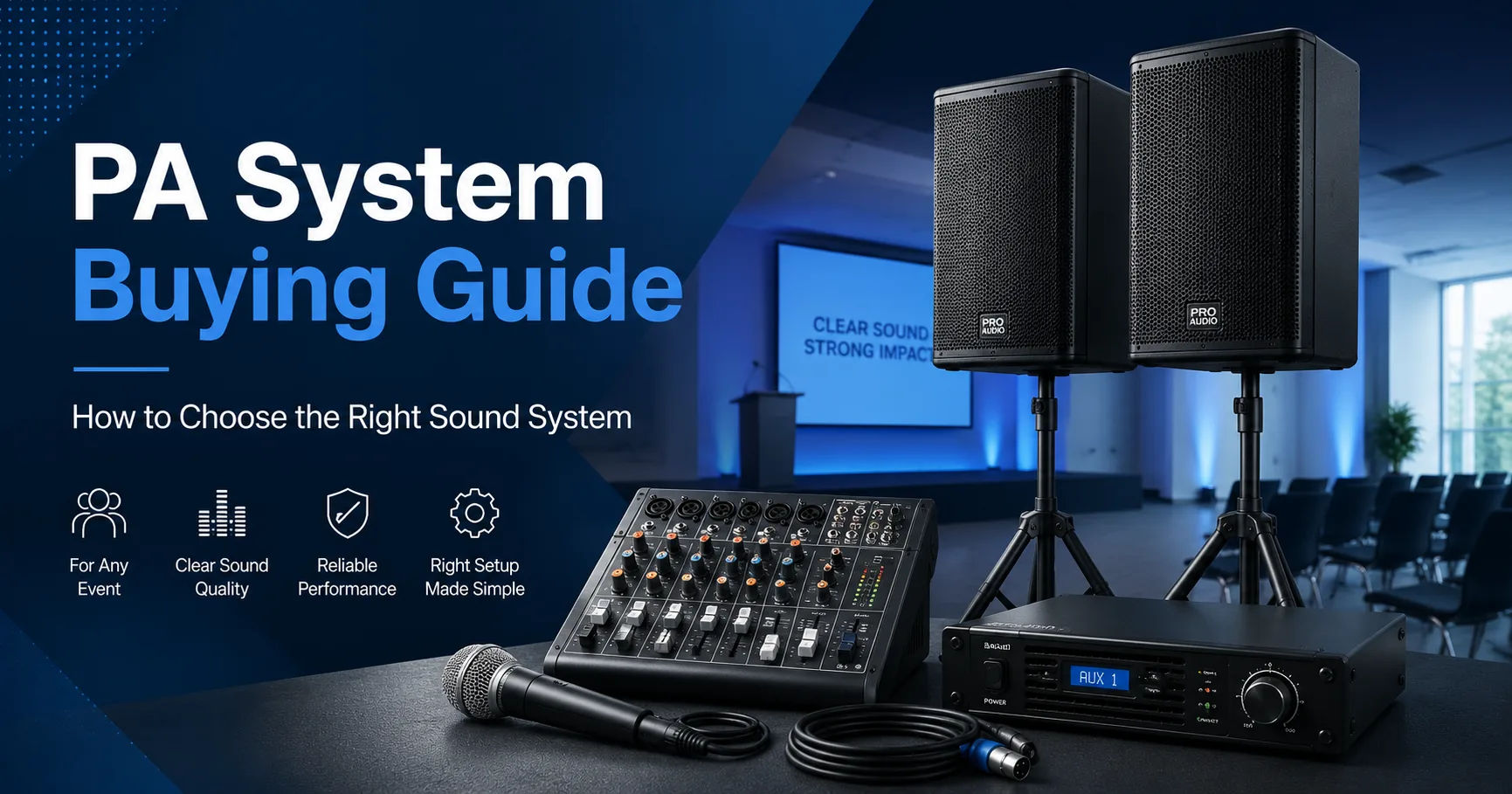
Choosing the Right PA System
A public address system can be used for meetings, seminars, educational institutions, religious venues, weddings, live performances, corporate events, outdoor programs, restaurants, retail spaces, and public announcements.
However, every application has different requirements. A system designed for a small meeting room may not provide sufficient coverage for an outdoor event. Similarly, a large concert setup may be unnecessary and difficult to operate in a small training room.
This PA system buying guide focuses on the most important factors that will help you choose a sound system that matches your actual requirements.
1. Identify Your PA System Requirements
Before comparing brands, speaker wattage, or cabinet size, first define how the PA system will be used. The intended application determines the required speakers, mixer inputs, microphone system, portability, and total budget.
Speech and Presentations
Prioritize vocal clarity, feedback control, microphone quality, and even coverage for meetings, seminars, and conferences.
Music and Live Performance
Look for full-range speakers, subwoofers, multiple mixer channels, stage monitors, effects, and suitable sound output.
Permanent Installation
Consider speaker placement, cable routes, audio zones, centralized control, reliability, and installation.
Portable Events
Choose lightweight equipment, active speakers, wireless microphones, durable cases, and a simple setup process.
Will the system primarily be used for speech, background music, live performance, announcements, or a combination of these applications?
2. Consider the Venue and Audience Size
Venue size and audience capacity are among the most important factors when choosing a PA system. The goal is not simply to make the sound loud. The system should provide balanced and intelligible audio throughout the entire audience area.
Small Indoor Spaces
Meeting rooms, classrooms, small restaurants, and training rooms usually need compact speakers with controlled coverage. One or two active speakers may be sufficient depending on the room layout.
Medium-Sized Halls
Conference halls, school auditoriums, community centers, and wedding venues may require two main speakers, subwoofers, multiple microphones, a mixer, and optional monitor speakers.
Large or Outdoor Venues
Large auditoriums and outdoor events require wider coverage, higher maximum output, additional speakers, delay speakers, subwoofers, or a line array system.
| Venue Type | Typical Requirement | Recommended Direction |
|---|---|---|
| Meeting room | Clear speech and simple operation | Compact active or column PA system |
| School or training hall | Speech, presentations, and music playback | Two full-range speakers with a mixer |
| Wedding or corporate event | Speech, music, and entertainment | Full-range speakers with subwoofers |
| Large outdoor event | High output and long-distance coverage | Multiple speakers or a line array system |
Speaker sensitivity, maximum SPL, coverage angle, venue acoustics, speaker placement, and background noise can be more important than advertised wattage.
3. Active vs Passive PA Systems
One of the first technical decisions is whether to buy an active PA system or a passive PA system.
| Feature | Active PA System | Passive PA System |
|---|---|---|
| Amplifier | Built into the speaker | External amplifier required |
| Setup | Faster and easier | Requires more planning |
| Portability | Suitable for mobile setups | More separate equipment |
| Flexibility | Simple but less modular | Highly flexible and scalable |
| Best For | Small to medium events | Large or permanent installations |
Choose an Active PA System When:
- You need quick and simple installation.
- The equipment will be moved frequently.
- You want fewer separate components.
- The system will be operated by a small team.
Choose a Passive PA System When:
- You need a large and customized sound system.
- The system will be permanently installed.
- You want centralized amplifier control.
- Future expansion and component matching are important.
4. Portable vs Installed PA Systems
Consider whether the PA system will remain in one location or regularly travel between different venues.
Portable PA Systems
Portable systems are suitable for rental businesses, event organizers, presenters, musicians, and temporary events. They should be lightweight, durable, easy to connect, and quick to operate.
Installed PA Systems
Permanently installed systems are suitable for schools, mosques, conference halls, offices, factories, restaurants, shopping centers, and auditoriums.
Choose a portable system when mobility and fast setup are priorities. Choose an installed system when consistent coverage, appearance, centralized control, and long-term reliability are more important.
5. Choose the Right Speaker Type
Different speakers are designed for different venues and applications. Selecting the correct type can improve clarity and reduce the need for excessive volume.
Full-Range Speakers
Suitable for speech, music playback, meetings, small events, and general PA applications.
Subwoofers
Add powerful low-frequency sound for weddings, DJs, performances, and live music.
Column Speakers
Provide controlled sound coverage for conferences, speech, presentations, and religious venues.
Line Array Systems
Designed for consistent and long-distance coverage in large indoor and outdoor venues.
Ceiling Speakers
Suitable for announcements and background music in offices, shops, restaurants, and commercial buildings.
Monitor Speakers
Allow presenters, singers, and musicians to hear themselves clearly while performing.
6. Check Power and Sound Coverage
Buyers often focus only on watts, but wattage does not provide a complete picture of speaker performance. Two speakers with the same power rating may produce different sound levels and coverage.
Important Specifications to Check
- Maximum SPL: Indicates how loud the speaker can play before reaching its operating limit.
- Coverage Angle: Shows how widely the speaker distributes sound horizontally and vertically.
- Frequency Response: Indicates the range of low, mid, and high frequencies the speaker can reproduce.
- Speaker Sensitivity: Shows how efficiently the speaker converts amplifier power into sound.
- Continuous Power Rating: Usually provides a more useful reference than peak or promotional power figures.
Several properly positioned speakers operating at a comfortable level often provide better results than one extremely loud speaker attempting to cover an entire venue.
7. Select the Right Mixer and Microphones
Choosing a Mixer
The mixer controls microphones, music players, instruments, computers, and other audio sources. Make sure it has enough channels for current use and future expansion.
- Count the required microphone and instrument inputs.
- Check whether phantom power is required.
- Look for USB playback or recording when needed.
- Consider built-in effects and equalization.
- Check auxiliary outputs for monitor speakers.
- Consider digital control for complex systems.
Choosing Microphones
| Microphone Type | Best Application | Main Advantage |
|---|---|---|
| Wired handheld | Speech, singing, and fixed podium use | Reliable and affordable |
| Wireless handheld | Events, presentations, and performances | Freedom of movement |
| Lavalier microphone | Training, interviews, and presentations | Hands-free operation |
| Headset microphone | Teaching, fitness, and stage performance | Consistent microphone positioning |
| Gooseneck microphone | Conference tables and podiums | Professional fixed placement |
8. Important PA System Features
Select features based on your actual operational requirements instead of choosing a system only because it has a long feature list.
- Bluetooth audio playback
- USB media playback
- Built-in audio mixer
- Wireless microphone compatibility
- Digital signal processing
- Feedback suppression
- Remote application control
- Battery-powered operation
- Multiple audio inputs
- Recording output
- Speaker protection system
- Weather-resistant construction
9. Set a Realistic Budget
The total PA system price includes more than the speakers. A complete setup may also require a mixer, microphones, amplifiers, speaker stands, cables, connectors, equipment racks, power protection, installation, and technical support.
Entry-Level Setup
Suitable for small meetings, classrooms, personal presentations, and basic announcements. These systems generally focus on portability and simple operation.
Mid-Range Setup
Suitable for schools, religious venues, corporate programs, restaurants, weddings, and medium-sized events.
Professional Setup
Suitable for large events, live performances, outdoor programs, and permanent installations requiring high reliability and professional sound control.
A low-cost system can become expensive when it provides poor sound, insufficient coverage, frequent repair requirements, or no future expansion.
10. Check Warranty and After-Sales Support
A PA system is a long-term investment. Reliable technical support, installation service, replacement parts, and warranty coverage can be as important as product specifications.
- Confirm that the product is original and authentic.
- Check the official warranty period and conditions.
- Ask whether spare parts are locally available.
- Confirm installation and configuration support.
- Check repair and maintenance facilities.
- Ask whether basic user training is available.
Select a system that allows you to add more microphones, speakers, subwoofers, audio zones, monitor speakers, or mixer channels without replacing the complete setup.
11. Common PA System Buying Mistakes
Buying based only on wattage: Wattage alone does not determine sound clarity, coverage, or maximum output.
Ignoring the venue layout: Walls, pillars, balconies, and open spaces affect sound distribution.
Choosing too few speakers: One loud speaker may create excessive volume at the front and weak sound at the back.
Forgetting accessories: Speaker stands, cables, connectors, cases, and power protection are essential.
Ignoring future expansion: A system with no additional inputs or outputs may need to be replaced later.
Ignoring warranty and support: Equipment without technical support can create expensive downtime.
12. PA System Buying Checklist
Review this checklist before requesting a quotation or purchasing a complete PA system.
- Define the main application
- Measure the venue dimensions
- Estimate the audience capacity
- Identify indoor or outdoor use
- Select active or passive speakers
- Choose portable or installed setup
- Calculate required audio inputs
- Select appropriate microphones
- Decide whether subwoofers are needed
- Check speaker coverage specifications
- Include cables and accessories
- Confirm future expansion options
- Verify authenticity and warranty
- Confirm installation and support
13. Recommended PA System Configurations
These examples provide a general starting point. Final equipment selection should be based on venue size, audience capacity, required sound level, and operating requirements.
Small Meetings and Presentations
- One or two compact active speakers
- Small audio mixer
- One or two wired or wireless microphones
- Laptop or media player connection
- Speaker stands and suitable cables
Schools and Training Centers
- Two full-range speakers
- Multi-channel audio mixer
- Wireless handheld and lavalier microphones
- Presentation audio input
- Optional recording output
Weddings and Corporate Events
- Two full-range main speakers
- One or two subwoofers
- Digital or analog mixer
- Multiple wireless microphones
- Stage monitor when required
Large Outdoor Programs
- Multiple high-output speakers or line arrays
- Professional subwoofers
- Digital mixer and signal processor
- Delay speakers for extended coverage
- Reliable power distribution and backup
Frequently Asked Questions
How do I choose the right PA system?
Choose a PA system based on the intended application, venue size, audience capacity, sound coverage, portability, speaker type, microphone requirements, budget, and future expansion needs.
Is an active or passive PA system better?
Active systems are easier to set up and transport because the amplifier is built into the speaker. Passive systems offer greater flexibility for larger or permanent installations.
Do I need a subwoofer for my PA system?
A subwoofer is recommended for live music, weddings, DJs, and events that need powerful low-frequency sound. It may not be necessary for speech-only applications.
How many PA speakers do I need?
Small rooms may require one or two speakers. Medium and large venues may require several speakers, subwoofers, delay speakers, or line arrays for even coverage.
What should I check before buying?
Check venue size, audience capacity, speaker coverage, maximum SPL, mixer inputs, microphone compatibility, product authenticity, warranty, installation, and after-sales support.
Need Help Choosing the Right PA System?
Share your venue size, audience capacity, application, and budget with our team. We can help you select a practical PA system configuration for your project.